During the course of my research, I struggled with trying to figure out what sort of data visualization would not only help showcase the connections I wanted to analyze between the post-trauma writings of China’s Cultural Revolution (Scar Literature) and those of post-South Korea’s democratization movement, the Gwangju Uprising but would also not be too hard for me to learn, as I am very much, computer illiterate. After reading the assigned text on the “Ming-Qing Women’s Writings Digital Archive,” I began to postulate whether or not textual analysis and, even further, topic modeling would be something I could do. Bringing together the notion of “top-down” versus “bottom-up” perspectives on history, I decided to create word clouds that would represent the point of views of those experiencing the events (bottom-up) and compare them not only between nations, China and South Korea but also to the top-down perspective, utilizing the writings and speeches of leaders, Mao Zedong, and Chun Doo-hwan. My first goal was to analyze the similarities and differences between the most commonly used words within the corpus, and, from there, comparatively, analyze the responses to trauma by the bottom-up works and analyze the attitudes of the top-down perspectives when referencing the same events. Since I am working with the personal letters and diaries of individuals betrayed by their government, I hypothesized that there would be a lot of bias to be found within this set of texts. Knowing that the respective governments’ response was to censor and silence anyone who tried to speak out, I also thought that the texts of the top-down perspective would be similar in their approach to blame the people while working to maintain their role as superior and in the right. Fundamentally, my selection of sources was also biased— I chose to use works written by people that had nothing positive to say about the events that I am looking at, so their differences from the top-down would be quite significant. However, this was done purposely; since I am just beginning to utilize data visualization and textual analysis, my current corpus size is relatively small, so I wanted to be able to demonstrate the sort of “ends of the spectrum.” However, my sources for this visualization are still very similar to the other primary sources that I wish to utilize— I am focusing on the analysis of primary sources with help from secondary sources and historical fiction. However, I want to insert myself and my perceptions of the events as little as possible. My goal is not to judge the event but analyze the responses. As I continue to work on my research and better incorporate the digital humanities, I would like to use a wider breadth of work that may or may not be so drastic in their differences.
My first set of word clouds (Fig.1) were created using the translated blood letters of prominent dissident Lin Zhao, who was later executed, her family billed for the price of the bullet they used to kill her, and Lee Jae-eui’s diary recounting the events of the Gwangju Uprising as they occurred around him (with the removal of chapters written by Bruce Cummings and Tim Shorrock). After importing my texts into the word cloud creator, Word Art, I removed numbers (including dates), stop-words, and prepositions, of which there were many, and formatted them into the shape of their respective country of origin[1]. After I finished creating the word clouds, I noticed some apparent similarities between the largest words depicted in the visualizations. Words such as “people” and “one” frequently appeared within both of the texts as well as the organizations that set out to harm them, with “party” and “Mao” being found in the rendering of Lin Zhao’s blood letters, and “military,” “paratrooper,” and “militia” being shared within the rendering of Lee Jae-eui’s diary[2].
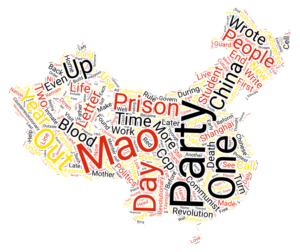
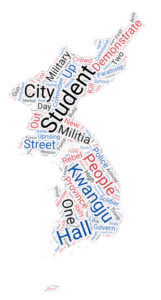
Figure 1. Two word clouds based on Lin Zhao’s blood letters (left) and Lee Jae-eui’s Kwangju Diary (right)
Likewise, there are similarities among the texts written by Mao and Chun Doo-hwan. I used the same steps to create these word clouds (Fig. 2), except with bold text, so they are distinguishable from the bottom-up perspective’s word clouds. Throughout the texts of Mao and Chun, references to the “people,” the “nation,” and themselves can be found, Mao referring to himself as “Chairman” and Chun as “President” though, at the time of the Gwangju Uprising, he was the military leader responsible for a coup d’état[3] against President Choi Kyu-hah.
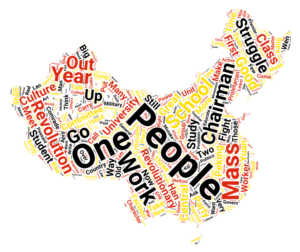
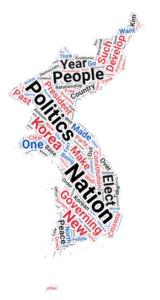
Figure 2. These word clouds depict the top-down perspective, utilizing the speeches and letters of Mao Zedong (left) and speeches given by Chun Doo-hwan following the Gwangju Uprising (right).
What I found to be unsurprising in my analysis is the lack of accountability throughout Mao and Chun’s texts. Later, through topic modeling (Fig. 3 and 4), I ran these same texts through MALLET and found that there were even more similarities between these texts than I had thought— what the computer decided to choose as the most “relevant” topics after running 2000 times all focused on the parties, the nation, and their motivations (for Mao, getting rid of the petty bourgeoisie and for Chun, any opposition to the military and his rise to power; namely the students).
19 2.5 committee central students problem end oppose Kwangju Chen make called student reform national order important social municipal attitude isolated
17 2.5 party bourgeoisie put question department communist side Marxism academic opposed art natural places meetings policy hands elements follow established
5 2.5 comrade power red political method wen yu guards hui liberation pal li organizations city Zheng wrote articles forward
18 2.5 time general members past situation force future china soviet anti issued troops congress depend union attending excellent trust met
4 2.5 country mistakes made long world proletariat bourgeois socialist classes correct victory carried wrong kill contradictions mass point exists rebel
Figure 3. Relevant topics from Mao’s decrees and writings that had some correlations with Chun Doo-hwan. Notice the multiple mentions of the people, the party, and communism
1 2.5 relationship world elected public absolutely write policy matters force peoples achieve carry results earnest directed Eason association leftist predominant
6 2.5 democratic recommendations communist red era make stability secret proceedings court comment difference relations question compromise politics laws wipe spread
12 2.5 president made years im culture historic students policies mind end handing long box supreme interfering court attempted criminal strength
18 2.5 development Korea nation continue proposals power principle analyses concession form reflected wheth throwing Koreans soldiers American raise shown understanding
4 2.5 peninsula improve groups insure reins sense prisoners active orders support allies involved investors business powers conference social life fully
Figure 4. Relevant topics from Chun’s speeches that correlate with Mao’s— again note communism and the nation’s mentions.
Through the analysis of topic modeling, the differences between Mao and Chun’s views on America and the West can also be seen—. In contrast, Mao refers to the imperialist bourgeoisie, Chun’s topic that references Americans contains words such as “development,” “understanding,” and “nation.”
Though these data visualization methods have allowed me to reach exciting conclusions on my sources, there is still much left to be uncovered. I wish that I was more adept at utilizing sources such as Voyant Tools that would aid me in showcasing the frequency in which the words appear and the context surrounding the word. There is a greater level of analysis that can be achieved through this analysis method, and I hope to one day be able to utilize it to find even more information on my research topic.
[1]I also changed the colors of the words to reflect their flags’ hexadecimal color code. I just thought that it looked nice.
[2] What truly surprised me about the rendering of Lee’s diary is the location in which Chonnam can be found on the map. Though these were randomly generated, Chonnam, the name of the university where the Gwangju Uprising began, is located in roughly the same location it can be found on a map. Located between “one” and “hall”, Chonnam sits within the Jeolla Province, Gwangju.
[3] Unsurprisingly, it was because of Chun’s coup against Choi that the Gwangju Uprising would even take place— after working his way to usurp the sitting president, Choi enacted martial law against anyone that refused to accept him as the new President.