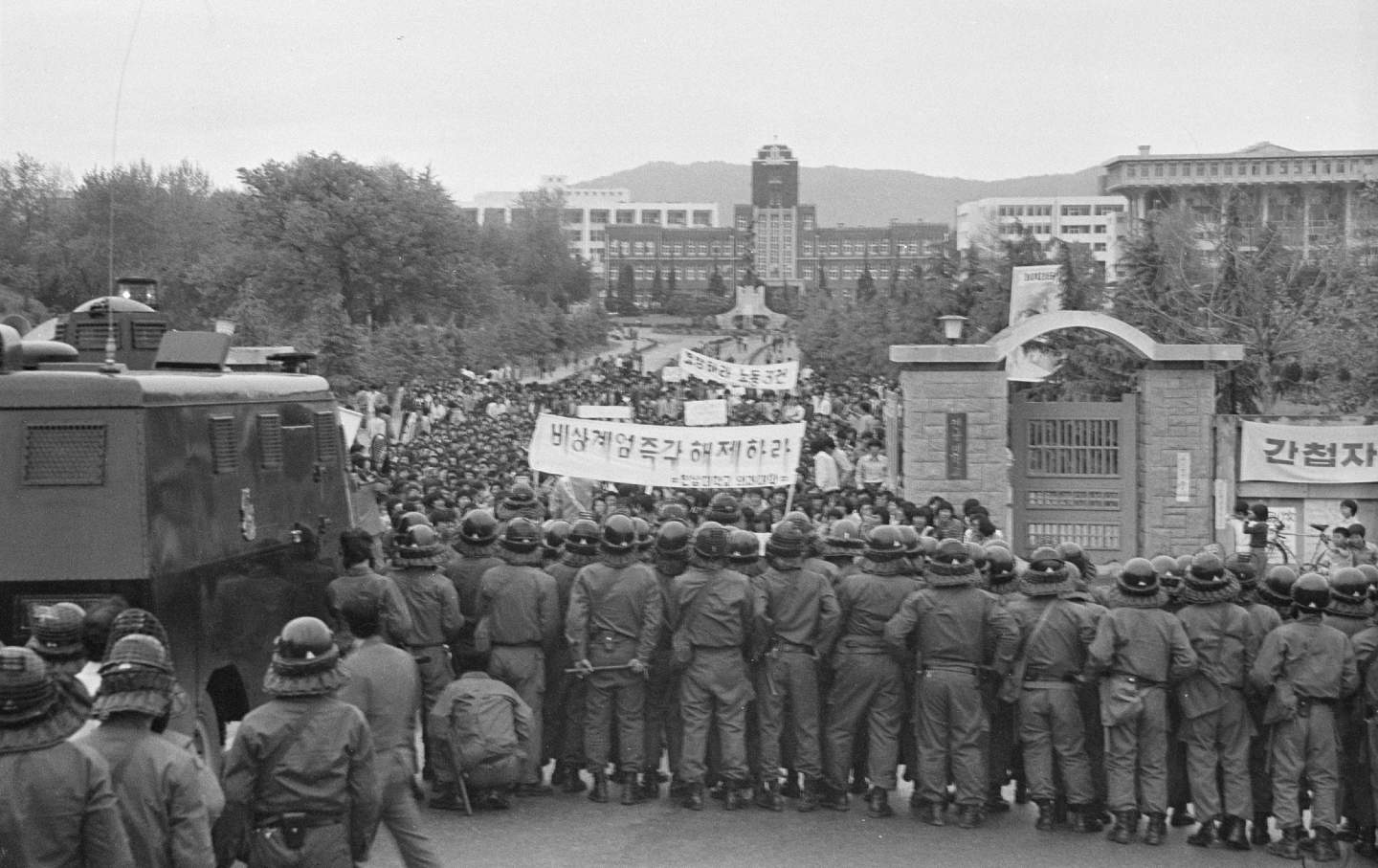
The Gwangju Uprising, also known as the May 18th Gwangju Democratization Movement, or simply, 5.18, occurred in Gwangju, Jeolla-do, South Korea from May 18th to May 27th, 1980. Students and faculty from Chonnam National University (CNU) led the democratization movement. As protests against the military dictatorship with Korea began, they were met with heavy suppression as the reign of Park Chung-hee[1] continued. It would not be until after his assassination in 1979 that the democratization movements across the peninsula resumed with a refound vigor. Although President Choi Kyu-hah[2] would come to power after President Park, he would not remain there for very long. The subsequent coup d’état by army general Chun Doo-hwan[3]would spark what was to become one of the world’s most forgotten and discredited democracy movements.
It would be the brutal death of Kim Gyung-cheol, a deaf 29-year-old in the wrong place at the wrong time, that would spark outrage amongst the people of Gwangju. What began as a march of roughly 600 students protesting against the suppression of academic freedoms soon ballooned into a city-wide demonstration of nearly 250,000. To combat the violent riot police and paratroopers sent out and ordered by Chun Doo-hwan, citizens broke into armories, arming themselves with whatever that could find. Brutal is an understatement. Footage of German reporter Jürgen Hinzpeter showcases how heinous the attacks on the citizens of Gwangju indeed were. Uncensored, bloody, beaten bodies, both alive and dead, in caskets and left on the streets, are filmed. The abuse of power and blatant lies told by Korean officials that the protestors were “communist insurgents”[4] was exposed to the world, as Hinzpeter’s smuggled footage is aired first in Germany, then subsequently on news stations internationally. The protests would last until May 27th, 1980, ending with Chun sending in tanks, armored vehicles, and even helicopters, ordered to attack indiscriminately[5]. Though Chun would later be sentenced to death for his orders to hunt down civilians, he would later be exonerated by President Kim Young-sam in 1996. While official reports claim the death toll to be around 200, Gwangju citizens argue that a minimum of 2,000 people were killed[6].
[1] Park Chung-hee was the father of former President Park Geun-hye, who was famously, the first female and the first impeached president for the nation. She subsequently received a sentence of 24 years in prison for corruption, abuse of power, influence-peddling, and colluding with notable pseudo-Christian cult leader’s daughter, and former advisor to Park Geun-hye, Choi Soon-sil. Although Park Chung-hee did not have the same sort of public scandal as his daughter, he would be known for coming to the presidency after first leading a strict military dictatorship, installed by the May 16th military coup d’état. Although his policies and economic growth would lead to the rapid industrialization and “Miracle on the Han River”, these programs came at the cost of the civil liberties and political freedoms of the citizens. It would be because of this that Park Chung-hee began to lose the popular vote, and multiple assassination attempts would be made on his life, one of which would claim his wife, Yuk Young-soo.
[2] After Park Chung-hee’s assassination, Choi would remain in office for less than a year as South Korea’s fourth president. From October 26th to December 6th, Choi would make promises of democratic elections and a new constitution to replace the Yushin Constitution. The Yushin Constitution was a heavily authoritarian document, the name alluding to the Meiji Restoration, its “imperial” role attached to Park’s presidency. This document extended the presidency to a 6-year term with no term limits and although the president was to be indirectly elected through a publicly elected electoral college, the requirements were so strict that only one candidate could be on the conference’s ballot. None of Choi’s plans would come to fruition, as Chun doo-hee’s military coup would take place in December of 1979, gaining virtually all control over the government by early 1980. As Chun’s power was questioned by the growing demonstrations, Choi appointed him as head of the Korean Central Intelligence Agency (the same that killed Park Chung-hee) and declared martial law. Once martial law had been called by Choi, Chun became the de facto ruler of South Korea.
[3] Though Chun doo-hwan would not be assassinated, history does indeed repeat itself, and the citizens of Korea fought tirelessly against the second military coup d’état under him, leading to the continued struggle of the people of Gwangju to be compensated for Chun’s actions. After being sentenced to death for his role in the Gwangju Massacre in 1996, he was pardoned by President Kim Young-sam. As of 2020, Chun has tried (and failed) multiple times to publish memoirs in which he defaces both reporters and survivors of the Gwangju Uprising, and though he has been sued multiple times, he remains adamant that he was not responsible (despite very clear evidence) for the massacre of Gwangju citizens. Cho Chul-hyun, a priest not immune to the slander of Chun Doo-hwan within his banned memoirs, called him “Satan wearing a mask” for his denial of responsibility after witnessing events such as helicopters shooting down citizens.
“(3rd LD) Former President Chun Stands Trial for Libel Over Gwangju Memoirs” Yohap News. March 11th, 2019
[4] In contrast to the “official” news outlet, Chosun Ilbo, which had close ties to the government, the Militant’s Bulletin began circulating on May 20th. Newspapers such as the Chosun Ilbo had categorized protestors as ‘hoodlums with guns’— a common tactic used by oppressive regimes to silence those fighting for the freedoms of marginalized groups.
Katsiaficas, George. In 1980: The Kwangju Uprising. The North-Eastern Federation of Anarcho-Communists, n.d.
[5] Jung, Da-min. “Chun Doo-Hwan Ordered 1980 Massacre Shooting.” Korea Times, May 14, 2019.
[6] “Archived copy” 5월단체, “5.18관련 사망자 606명” (in Korean). Yeonhap News. May 13th 2005. Archived form the original on December 2, 2013