Monthly Archives: December 2020

MEMOIR AND HISTORICAL FICTION ABOUT THE REVOLUTION

Without exception, all novels, in some way, involve history. There is no way one can exist without the acknowledgement of and participation in history– even those that remain on the periphery of what is often regarded as historical fact, are a part of history. This is especially  in the writings on the Cultural Revolution and the Gwangju Uprising. Heavy censorship made discussion of these two revolutions nearly impossible during the periods in which they occurred, however, it is precisely because of this that the memoirs and trauma writings borne out of these events are often considered to be both non-fiction and fiction. Utilization of fiction or ‘altered societies’ in order to describe the current happenings of a society is not new and, in the case of China, dates back to the Shijing (The Book of Songs), considered the oldest poetry anthology in China. This is why it is no surprise that these novels are, oftentimes,  more historically accurate than the historia patria. 

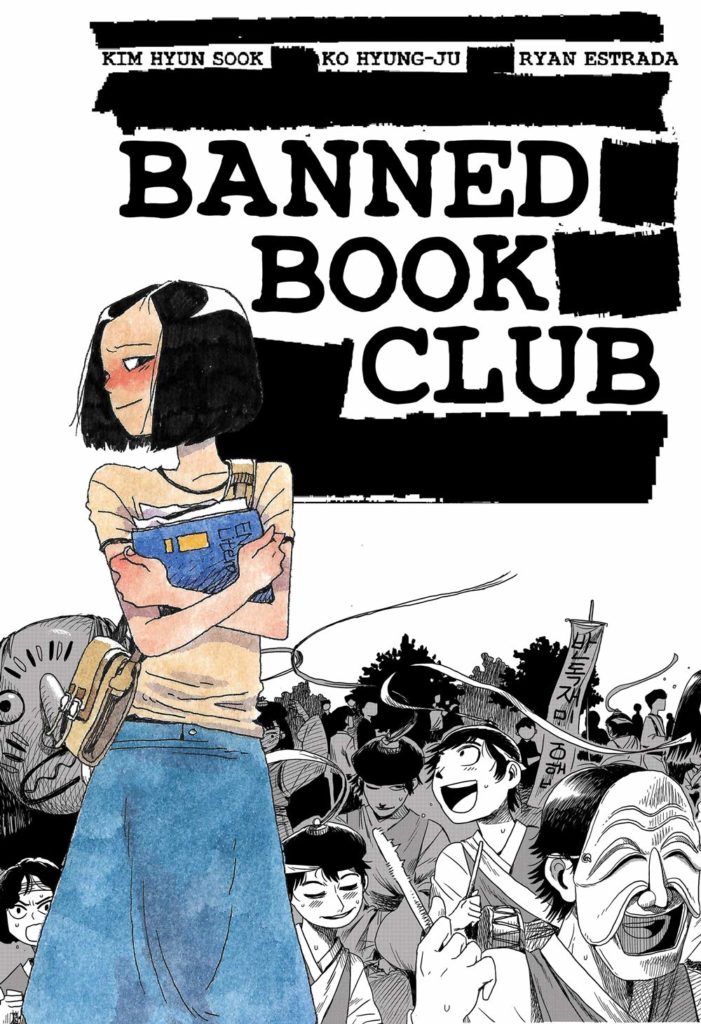
Banned Book Club presents the true story of a South Korean woman’s student days in college in the early 1980s. Under an authoritarian regime she found — through the rebellion of reading — her purpose and learned how powerful a tool censorship can be.

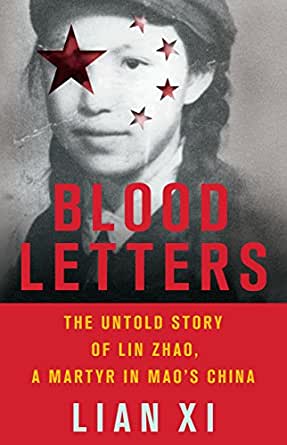
Throughout Lin’s imprisonment, where she was subjected to extreme torture, she wrote thousands of letters and essays in her own blood. Those letters are now kept at the Hoover Institution on War, Revolution, and Peace at Stanford University. Gan Cui, Lin’s fiancé, spent four months hand-copying Lin’s blood letters when they first became available to Lin’s siblings, her only remaining family.

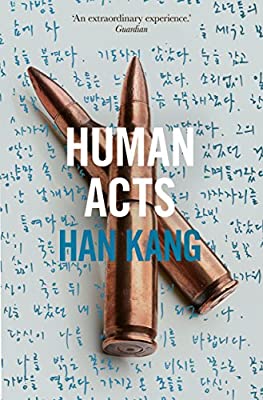
Brutal and uncompromising; Human Acts  begins with a flourish of blood and barbarity that is fast and unexpected. While focusing on the death of high schooler, Dong-ho, who is killed by paratroopers during the outing, Han Kang guides readers through the tumultuous journey his family and fellow citizens take after experiencing the horrors of Chun Doo-hwan’s martial law.

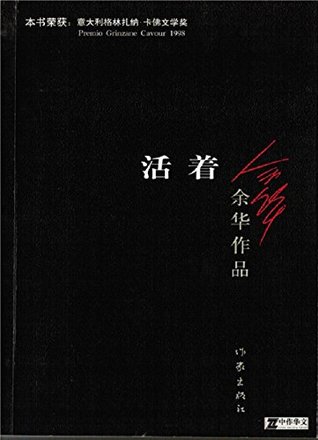
This searing novel, originally banned in China but later named one of that nation’s most influential books, portrays one man’s transformation from the spoiled son of a landlord to a kindhearted peasant. After squandering his family’s fortune in gambling dens and brothels, the young, deeply penitent Fugui settles down to do the honest work of a farmer. Forced by the Nationalist Army to leave behind his family, he witnesses the horrors and privations of the Civil War, only to return years later to face a string of hardships brought on by the ravages of the Cultural Revolution. Left with an ox as the companion of his final years, Fugui stands as a model of gritty authenticity, buoyed by his appreciation for life in this narrative of humbling power.


SECONDARY SOURCE REVIEW (Cultural and Literary Trauma)


Michelle Balaev. 2014. 1 Literary Trauma Theory Reconsidered. In: Michelle Balaev, ed. Contemporary Approaches in Literary Trauma Theory. Pallgrave MacMillan, pp. 1-14.


Ron Eyerman. 2019. Memory, Trauma, and Identity. Switzerland: Springer Nature Switzerland AG.


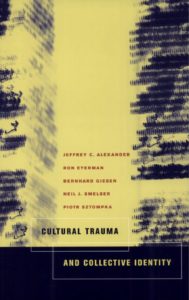
Neil J. Smelser. 2004. Psychological Trauma and Cultural Trauma. In: Cultural Trauma and Collective Identity. Berkley, California: University of California Press pp. 31-59.


Article Review

In these selected chapters, Michelle Balaev, Ron Eyerman, and Neil J Smelser focus on literary trauma theory and cultural trauma theory to describe the importance and necessity of trauma writing. Though these chapters are found in different books on trauma theory, one can utilize these sources in order to develop and explicate cultural trauma and how it can be applied to the new pluralistic model of literary trauma theory that Balaev introduces in her chapter.

Balaev’s chapter sets out to define what literary trauma theory includes and how it has since evolved from its classic model into a more pluralistic one. The pluralistic literary trauma theory model introduced in Balaev’s chapter gives survivors agency over their own stories and allows for a wide breadth of experiences to be recorded. While working to introduce readers to what literary trauma theory refers to, Balaev makes use of previous scholarship to first define what contemporary definitions of literary trauma theory is not. While citing Cathy Caruth and Sigmond Freud, Balaev, makes the claim that the previous ways in which trauma, specifically trauma writing, has been viewed by scholars and so-called “experts” in the field is not only deeply flawed, but embedded within it is too great of an importance on  dissociation from a traumatic event. Balaev describes the removal of the survivor’s agency surrounding a traumatic event through dissociation as paradoxical— though survivors are the ones that have directly experienced the traumatic event, according to the classic theory, they have the “absolute inability to know it[1], thus, restricting the variability of trauma.

What Balaev wants to be most understood about literary trauma theory, and in turn, trauma writing, is that although a survivor may have had little agency in the moment of the traumatic event, there is variability in trauma and its definition and representations; it is not only unfair to make the claim that survivors  must dissociate and not recognize their own trauma for it to be legitimate, but factually incorrect.

However, Balaev’s chapter does not set out to provide examples and further explain what it means to be affected by these models of literary trauma theory. Though they consider previous definitions as well as the works of former scholars, this chapter does little to add to the conversation on what is trauma writing and how the pluralistic  model of literary trauma theory allows for trauma writing to even be possible. Balaev also does not describe the important connections between trauma and memory; though they begin to discuss the numerous ways that trauma may be expressed, stating that it is much more than dissociation, they fail to bring up more examples that combat Caruth’s classic theory.

Where Balaev falls short, however, Ron Eyerman and Neil J Smelser pick up the difference, which is why I chose to look at chapters by these scholars as well. Balaev’s chapter works as a great introduction to the much more thorough and meticulous ones by Eyerman and Smelser.

Working to define memory and cultural trauma, Eyerman calls upon Smelser in his book in order to create the current definition for cultural trauma, stating that cultural trauma occurs “when members of a collectivity feel that they have been subjected to a horrendous event that leaves indelible marks upon their group consciousness, marking their memories forever and changing their future identities in fundamental and irrevocable ways”[2]. Eyerman, who is trained as a sociologist, focuses most of his research in this book around African American literature and the experience that being enslaved has had generationally. What is so significant about Eyerman’s work, is their chronological approach to trauma— beginning with cultural trauma, they systemically delineate the process of moving from event, to memory, to the formation of a new identity that sets out to redefine the group or person. Eyerman expounds upon his and Smelser’s definition of cultural trauma by using it to explain how there is a difference in which perpetrators and survivors respond to trauma and how the process in which these groups understand and acknowledge trauma still is dynamic, changing continuously.

Although Eyerman, quite literally, wrote the book on cultural trauma, within it there is oftentimes too much responsibility placed upon survivors to find new meaning within their trauma and forgive the perpetrators. Eyerman gives too much credit to perpetrators, with options ranging from minimizing their culpability for their wrongdoings and rewriting the historical memory of an event to acknowledging said wrongdoings with the risk of disidentification from the group[3]. However, as I stated, Eyerman writes on topics such as that of the enslavement of African Americans. Though he is an outsider to this community, he has found justification in speaking for them in general terms of “victim” versus “perpetrator” while working to decide on what the “appropriate” response to that event should be in order to supply a basis for inter group understanding.

Out of the chapters I looked at, Neil J Smelser’s offers not only the most methodological approach to cultural trauma, but the explanations of it that I enjoy the most. Smelser’s chapter examines trauma from a psychological standpoint, making use of lists and charts to describes the ways in which trauma presents itself, both to an individual and a collective group. Smelser takes the definition they created with Eyerman and expounds upon it, adding that traumas are “made not born”[4], which, in turn, solidifies their own interpretation on the role of trauma within the literary scene— that it requires interpretation. Unlike Caruth and the classic theory, Smelser builds upon Balaev’s pluralistic model, not only considering, but demanding that the linguistic relationship between trauma should be acknowledged[5]. Smelser also furthers Eyerman’s points on the role of memory when discussing trauma, bringing up how it can be used to both memorialize as well as silence a traumatic event. Memorialization comes in various forms, and within the United States is most notable in the remembrance campaigns for 9/11. These attitudes are often not upheld when it comes to acknowledging when a nation or people has done wrong, and oftentimes we are told to “put the past behind us” in cases such as these (the enslavement of African Americans, the controversy surrounding Holocaust memorials)[6].

At the beginning of their chapter, Smelser describes its limitations, reminding readers that it is a chapter on cultural trauma within a book dedicated to its study. Taking note that it is meant to be selective in nature, as well as told from a psychological perspective, the reader is already made aware of the contents and what to expect to get out of the reading. This is very much my favorite reading on cultural trauma theory. Smelser does an excellent job of explaining theoretical points while making them accessible to an uninformed reader who may be unfamiliar with trauma theory and its writings.

What is so engaging about trauma fiction is its ability to engage readers into the ethical dilemmas of trauma. It is trauma in fiction that produces the awareness of the multidimensionality of a traumatic event, and in particular, the social influences that shape the survivor’s personality, the textual modeling of the individual’s mind, and the ability for readers to engage in a “compassionate correspondence between reader and survivor”.[7] This shift from the classic trauma theory of Caruth to the pluralistic model of newer scholars allows for the formerly described “inherently indecipherable’ to that which is not only represented through linguistics but perhaps, even, best represented through linguistics by expanding the range of values and contesting the very definition of trauma and mark the ever-expanding borders of the field of trauma writing.


[1]Michelle Balaev. 2014. 1 Literary Trauma Theory Reconsidered. In: Michelle Balaev, ed. Contemporary Approaches in Literary Trauma Theory. Pallgrave MacMillan, pg. 7

[2] Ron Eyerman. 2019 Memory, Trauma, and Identity. Switzerland: Springer Nature Switzerland AG pg. 3

[3] Ron Eyerman pg. 50-51

[4] Michelle Balaev pg. 10

[5] Michelle Balaev pg. 7

[6] Neil J Smelser. 2004. 2 Psychological Trauma and Cultural Trauma. Cultural Trauma and Collective Identity. Berkley, California: University of California Press. Pg. 53

[7] Michelle Balaev pg. 10

PRIMARY SOURCE ANALYSIS (GWANGJU)

Lee Jae-eui’s Kwangju Diary, tells the first person account of Lee’s active involvement in the Gwangju Uprising as a sophomore at CNU. The text, which truly reads as a diary, recounts the days of the movement, including maps drawn by Lee[1] of the routes taken by both protestors and paratroopers. Its major strength lies in its clear and concise organization, utilizing time tables in order to create a chronological retelling of the events of the uprising. The footnotes within the text also add to the breadth of information within, including personal details of activists and reporters, offering a deeper understanding of the key players involved in the movement. But what is so important about this source, is its personal connection to the events of the uprising— it is a counter-site to the historia patria[2] that, for decades, has worked to discredit the movement. Where the Kwangju Diary falls flat is in its revision.
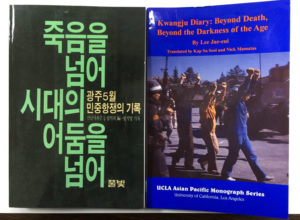
The original Kwangju Diary is nearly impossible to find— a target of heavy censorship, the diary’s production was not only limited but also strictly regulated[3]. The English revision, the only version I was able to obtain, has had entire chapters removed and replaced with essays written by Americans. Though these essays were written by Bruce Cummings, a historian as well as the world’s foremost expert on Korea, and Tim Shorrock, a writer and commentator on foreign policy and East Asian politics, and, while  very informed on the subject matter, the omission of Lee Jae-eui’s own words is very upsetting. The choice of the translators and editors, also all American, to remove many of the names of locations and people in order to “clarify” the text for an English-speaking audience is also unacceptable. The text in its original form, is written from the bottom-up perspective— following Lee’s time as a student activist, Kwangju Diary offers an intimate look at the happenings of a city truly under duress. With the inclusion of Cummings and Shorrock’s essays, we are also given a top-down, outside perspective of the uprising. Since both of their editions were written well after the actual event, they offer a more nuanced, scholarly, rather than emotional, view of the massacre.

It is quite clear that in the English revision, that the intended audience is that of an uninformed, English-speaker. The book includes a detailed account of the translation process as well as a note from Lee where he discusses the creation of the English version. Again, we see what weakness the text has when analyzing who was involved in the editorial process[4] because of the lack of the involvement of Korean scholars.
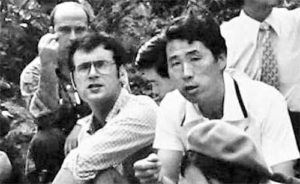
Where Lee Jae-eui’s Kwangju Diary offers a written account of the Gwangju Uprising, 5.18 힌츠페터 스토리, a documentary utilizing the smuggled footage of German reporter, Jürgen Hinzpeter showcases how heinous the attacks on the citizens of Gwangju truly were. Originally aired over  the course of 15 years as a Sunday special, the film, 5.18 힌츠페터 스토리[5], brings together the decades old footage of Hinzpeter from the uprising juxtaposed to interviews conducted from 2003-2018.Compiled, directed, edited, and narrated by KBS producer, Jane Youngjoo, the film works to create a cohesive story of Hinzpeter and the footage that made him famous.
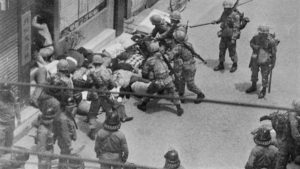
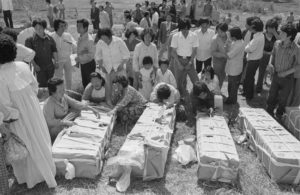
Unlike Lee’s diary, Hinzpeter’s footage within the film is not censored. Bloody, beaten bodies, both alive and dead, in caskets and left on the streets, are filmed. The abuse of power and blatant lies told by Korean officials, that the protestors were “communist insurgents” is exposed. The original footage and photographs within the documentary were not commissioned; Hinzpeter had frequently visited Korea in the past working as a correspondent in Japan for the ARD[6]. Within the documentary, Hinzpeter tells how, after being alerted of the situation in Gwangju by German missionary, Paul Schneiss, he headed to Gwangju. Though I am uncertain if the  documentary was commissioned or not, it was produced under KBS[7]. Responsible for everything from the news, to variety and music programs, to dramas, KBS maintains its status as a long-standing and dominant force within the Korean media sphere. To ignore the influence and power that KBS has as a broadcasting company would be ignorant. Though this documentary may have been produced solely for educational purposes, one simply cannot ignore the inherent biases held by such a powerful organization.
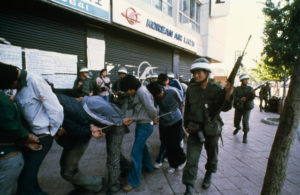
Other than the inclusion of interviews of survivors of the Gwangju Uprising, The Hinzpeter Story showcases footage of the uprising as it occurred— the atrocities committed by the paratroopers that the government adamantly denied[8] and worked to censor, were put on display for the world to see, and the news footage of this discovery is included. Like Lee’s diary, these images act as counter-sites to the historia patria. However, with the inclusion of recent scholarship, the documentary also sheds light on the United State’s involvement[9] in the uprising in new and profound ways.

While the film works hard to bring attention the the uprising, it has a tendency to over embellish details of key players such as Kim Sa-bok[10], changing their narratives entirely. Rather than recognized for his role in Hinzpeter’s ability to collect the footage of Gwangju, he is reduced to simply the “taxi driver” that meets Hinzpeter by happenstance. Though this is rectified later in the film as his son, Kim Seung-pil, gives his own interview, Kim Sa-bok’s story lacked the attention that Hinzpeter’s had, and as a result, there is no interview done by Sa-bok, as he died prior to the film’s completion[11].

In conjunction, these sources serve as a testimony to the violence Gwangju faced at the hands of its own government. Though these sources work well on their own, it is through the analysis of both of them together that a deeper understanding of just how bad the treatment of civilians were during this time. Without those that sacrificed themselves for this democratization movement, Korea would be much different from what we know it as today. It is also safe to say, that without the production of these sources that the world may never have known the sacrifices of Gwangju. Sources on the events in Gwangju remain very difficult to find and out of what is made available to the public, the perspectives offered in both Lee’s Kwangju Diary and Hinzpeter’s found footage within 5.18 히츠페터 스토리 are some of the most personal accounts on an event that would go down in history as a testament to the tenacity of those fighting an authoritative regime, and paving the way for South Korea’s future democratization.


[1] The images of the maps within the English revision were all redrawn by Seiee Kim of the Pratt Institute, and do not include the original location names in order to make it more “accessible” to an English-speaking audience.

[2] Putnam, Lara. “The Transnational and the Text-Searchable: Digitized Sources and the Shadows They Cast.” The American Historical Review 121, no. 2 (2016): 377–402. https://doi.org/10.1093/ahr/121.2.377. Pg. 381

[3] The revised English version was also very difficult to find. If not for the dark web, I may not have been able to find this source OR 5.18 힌츠펱 스토리. Sources to come from Korea during this time remain heavily censored, with access still restricted.

[4] Outside of Lee Jae-eui, only three Koreans were involved in the reproduction of this text. Mentioned above, Seiee Kim was responsible for the reproduction of the maps, Kap Su-seol, the translation, and Soo Kyung-nam for proof-reading. As such, this text is presented, not as a translation, but as a “revised edition” (Lee, 9).

[5] Translated as The Story of Hinzpeter

[6] ARD, short for Arbeitsgemeinschaft der öffentlich-rechtlichen Rundfunkanstalten der Bundesrepublik Deutschland, is an independent broadcasting station founded in West Germany, 1950, that focused on post-war broadcasts.


[7] KBS, short for Korean Broadcasting System, was founded by the government in 1927, with it becoming independently owned in 1973, stands as one of the largest and most profitable broadcasting companies in Korea.

[8] Deniers of the Gwangju Uprising remain in Korea, and it is commonly used as a test to see who is and is not a right-wing conservative versus a  left-wing progressive.

[9] The Cherokee Files is a collection of declassified documents that contradict previous statements made by the United States government on their role and involvement in the Gwangju Uprising. Included in the files, is a document stating that not only did President Carter’s administration know about President Chun’s intended use of military force in Gwangju, but they supported it, knowing of the plan a full ten days prior to the deployment of troops to Gwangju.

[10] The film Taxi Driver is the greatly loved, though inaccurate, retelling of Kim Sa-bok’s involvement with Hinzpeter.

[11] His son, Kim Seung-pil, would say in another interview, that the liver cancer his father died from in 2016 was largely caused by his father’s heavy drinking after witnessing the uprising, telling his son that he deplored how how “members of the same people can be so cruel to each other”.
 

FILM REPRESENTATIONS OF REVOLUTION

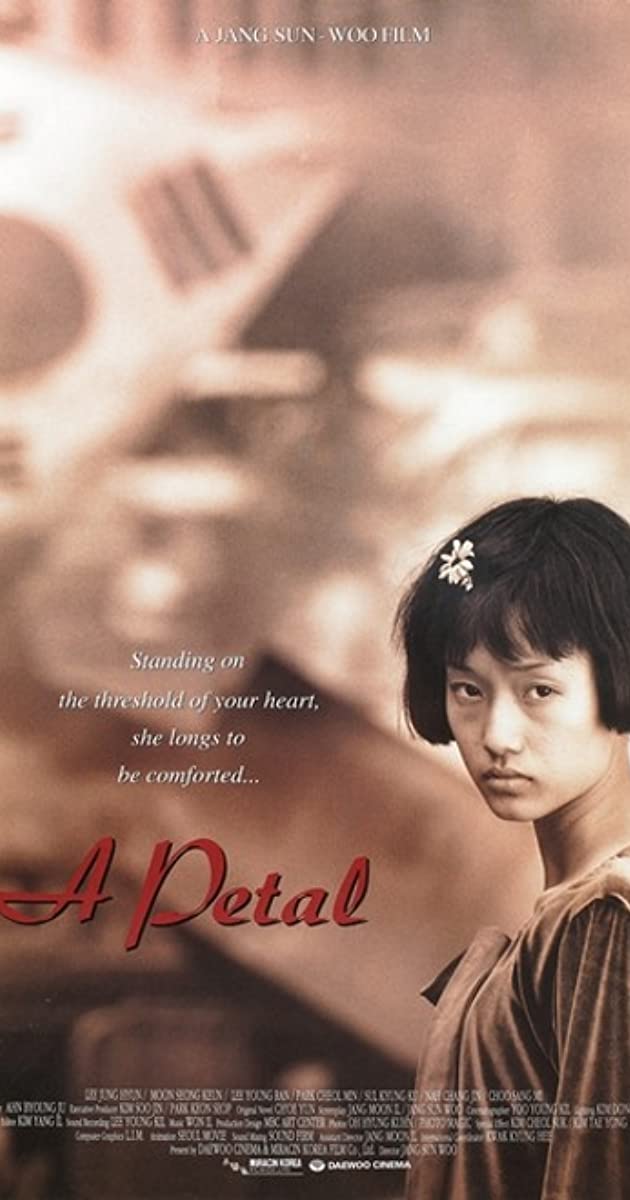
A Petal (1996)

A Petal is not only very unique in its storytelling, but also the way in which we grow up with “girl” after she experiences the trauma of the Gwangju Uprising. We see how lasting the effects of the revolution are. and the film does not hold back on graphic details of the uprising–showcasing scenes depicting bodies being dragged through the streets, and students (children even) taken out by paratroopers with their mothers crying over them.

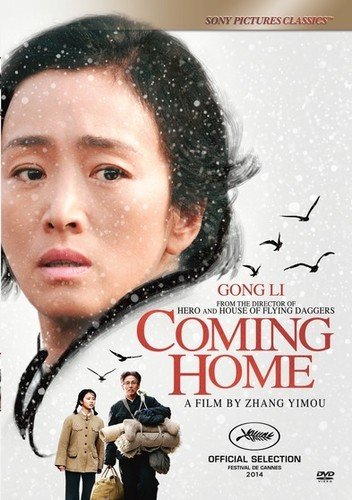
Coming Home (2014)

Directed by Zhang Yimou, Coming Home tells the story of former political prisoner (Chen Daoming)as he tries to help his wife (Gong Li) regain her memory and rediscover their love for each other.

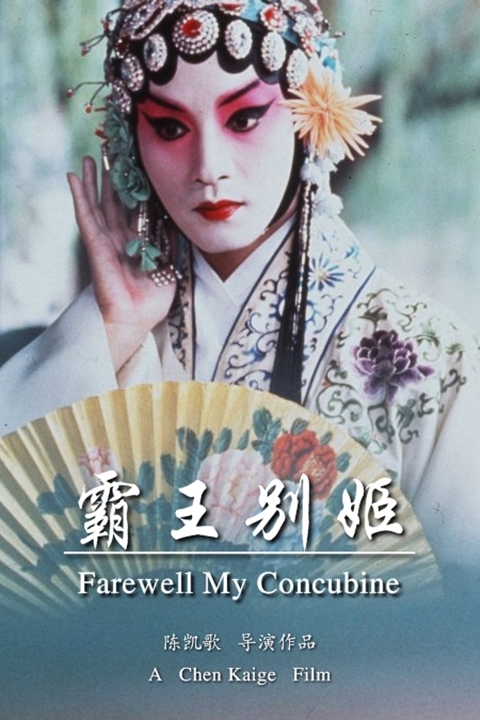
Farewell My Concubine 霸王別姬 (1993)
Farewell My Concubine tells the story of the lives of two Peking opera actors, Cheng Dieyi (played by Leslie Cheung) and Duan Xiaolou (Fengyi Zhang), from their youth and rigorous training in the 1920s to the years after the traumatic Cultural Revolution. Starring the much-loved actress Gong Li as Juxian, the woman who comes between the men, the film was noteworthy for its honest depiction of homosexual love and society’s role in the betrayal of loved ones.


A Taxi Driver

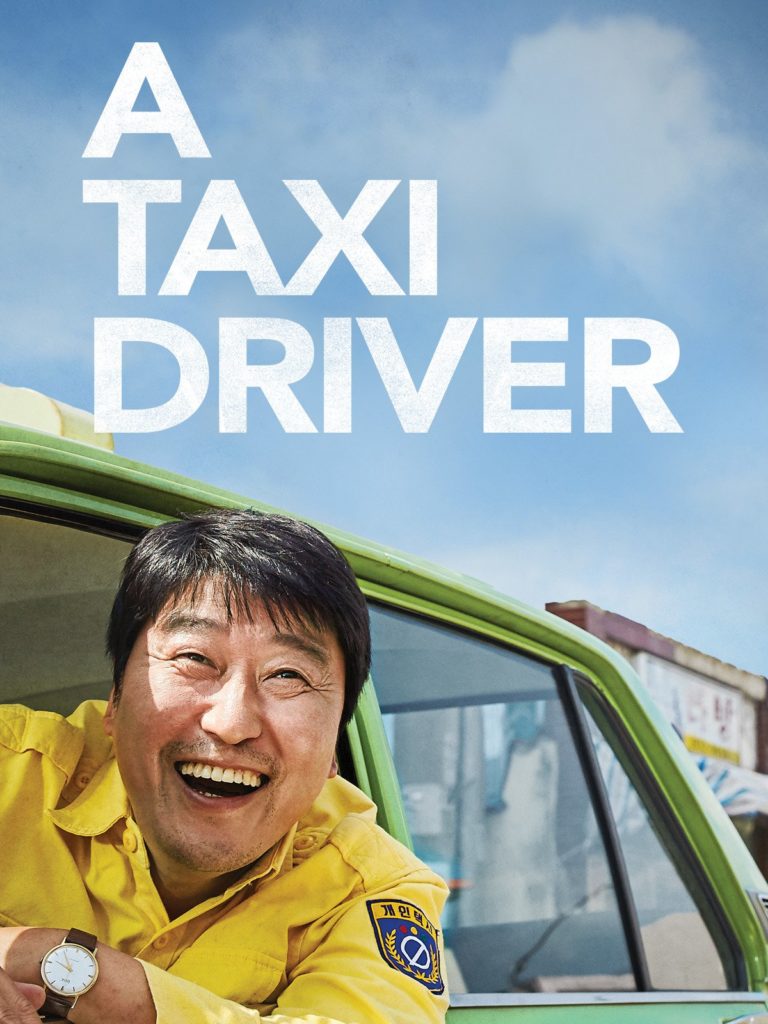
Though it has been embellished, A Taxi Driver is based on the true story of German reporter, Jürgen Hinzpeter and Korean taxi driver, Kim Sa-Bok. In the film, Kim drives Hinzpeter to Gwangju in order to aid in him covering the 1980 uprising but he soon finds himself regretting his decision after being caught in the violence around him. May 1980.


CONCLUSIONS


My data visualizations supported my hypothesis that there are many similarities in the topics of scar literature and the trauma writings of survivors of the Gwangju Uprising. However, it does not depict the similarities between the environments in which they were created. Unlike other literary and cultural movements occurring in East Asia during this period, the literature borne out of these traumatic events was primarily created by very young writers. During their coming-of-age period, these youth that experienced this trauma rarely had access to works deemed forbidden[1] by the regimes that governed them. Despite this, there is a strong desire to tell their story present in their trauma writings. Spontaneous and raw, their stories often lacked the refined techniques of former literary greats, yet their richness in expression and experiences provide, arguably, the most genuine and accurate depiction of these generations. To ignore these writings would be ignoring these experiences, and often, the youth’s vision of the future. Xu Bing, the artist of A Book from the Sky as well as a survivor of the Cultural Revolution, has said that “…if you want to probe deeply into the underpinnings of contemporary Chinese art, you have to consider the influence of the Cultural Revolution on [that] generation because it was entirely a unique experience”.[2] These representations of the traumatic event that they experienced reveal how trauma is recognized as their identities are transformed, how they processed their trauma through writing, how the agents that caused these tragedies in their writings can showcase more about the present ways in which tragedy is processed. The Cultural Revolution and the Gwangju Uprising are very complex historical, political, social, and ideological events that have left a deep scaron their respective nations’ hearts and minds. Through the analyses of the bottom-up perspective, we can learn how trauma is expressed culturally, and through the analyses of the top-down perspective, we can watch for signs and prevent trauma of this scale from happening again[3], that is if we listen.

[1] “Forbidden” works could include anything from theory, religious texts, and, in the case of some students in Gwangju, poetry written by authors such as Kim Ji-ha. There is a very interesting graphic novel titled Banned Book Club, that details the experience of Kim Hyun Sook, and her experience as a freshman at university in 1983, three years after the Gwangju Uprising, yet still in the middle of Chun Doo-hwan’s oppressive regime.

[2] Xu Bing. Interview with the author, May 27, 2000, Sydney.

[3] South Korea’s impeachment of Former President Park Geun-hye is an excellent example of a country learning from its past; however, due to the continued nature of Chinese politics, the same cannot be said for the continued support of President Xi Jinping.

“Xi Jinping’s brand new Cultural Revolution”. Taipei Times. 2018-08-23.


METHODOLOGY AND ANALYSIS

During the course of my research, I struggled with trying to figure out what sort of data visualization would not only help showcase the connections I wanted to analyze between the post-trauma writings of China’s Cultural Revolution (Scar Literature) and those of post-South Korea’s democratization movement, the Gwangju Uprising but would also not be too hard for me to learn, as I am very much, computer illiterate. After reading the assigned text on the “Ming-Qing Women’s Writings Digital Archive,” I began to postulate whether or not textual analysis and, even further, topic modeling would be something I could do. Bringing together the notion of “top-down” versus “bottom-up” perspectives on history, I decided to create word clouds that would represent the point of views of those experiencing the events (bottom-up) and compare them not only between nations, China and South Korea but also to the top-down perspective, utilizing the writings and speeches of leaders, Mao Zedong, and Chun Doo-hwan. My first goal was to analyze the similarities and differences between the most commonly used words within the corpus, and, from there, comparatively, analyze the responses to trauma by the bottom-up works and analyze the attitudes of the top-down perspectives when referencing the same events. Since I am working with the personal letters and diaries of individuals betrayed by their government, I hypothesized that there would be a lot of bias to be found within this set of texts. Knowing that the respective governments’ response was to censor and silence anyone who tried to speak out, I also thought that the texts of the top-down perspective would be similar in their approach to blame the people while working to maintain their role as superior and in the right. Fundamentally, my selection of sources was also biased— I chose to use works written by people that had nothing positive to say about the events that I am looking at, so their differences from the top-down would be quite significant. However, this was done purposely; since I am just beginning to utilize data visualization and textual analysis, my current corpus size is relatively small, so I wanted to be able to demonstrate the sort of “ends of the spectrum.” However, my sources for this visualization are still very similar to the other primary sources that I wish to utilize— I am focusing on the analysis of primary sources with help from secondary sources and historical fiction. However, I want to insert myself and my perceptions of the events as little as possible. My goal is not to judge the event but analyze the responses. As I continue to work on my research and better incorporate the digital humanities, I would like to use a wider breadth of work that may or may not be so drastic in their differences.

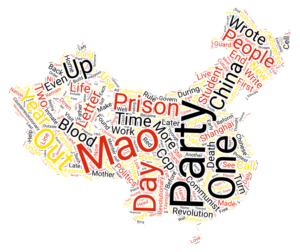
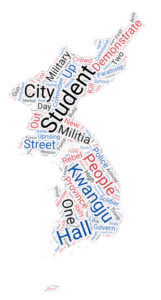
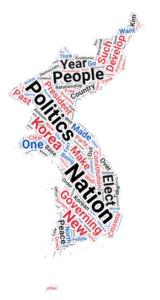
My first set of word clouds (Fig.1) were created using the translated blood letters of prominent dissident Lin Zhao, who was later executed, her family billed for the price of the bullet they used to kill her, and Lee Jae-eui’s diary recounting the events of the Gwangju Uprising as they occurred around him (with the removal of chapters written by Bruce Cummings and Tim Shorrock).  After importing my texts into the word cloud creator, Word Art, I removed numbers (including dates), stop-words, and prepositions, of which there were many, and formatted them into the shape of their respective country of origin[1]. After I finished creating the word clouds, I noticed some apparent similarities between the largest words depicted in the visualizations. Words such as “people” and “one” frequently appeared within both of the texts as well as the organizations that set out to harm them, with “party” and “Mao” being found in the rendering of Lin Zhao’s blood letters, and “military,” “paratrooper,” and “militia” being shared within the rendering of Lee Jae-eui’s diary[2].


Figure 1. Two word clouds based on Lin Zhao’s blood letters (left) and Lee Jae-eui’s Kwangju Diary (right)


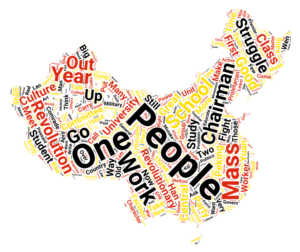
Likewise, there are similarities among the texts written by Mao and Chun Doo-hwan. I used the same steps to create these word clouds (Fig. 2), except with bold text, so they are distinguishable from the bottom-up perspective’s word clouds. Throughout the texts of Mao and Chun, references to the “people,” the “nation,” and themselves can be found, Mao referring to himself as “Chairman” and Chun as “President” though, at the time of the Gwangju Uprising, he was the military leader responsible for a coup d’état[3] against President Choi Kyu-hah.


Figure 2. These word clouds depict the top-down perspective, utilizing the speeches and letters of Mao Zedong (left) and speeches given by Chun Doo-hwan following the Gwangju Uprising (right).


What I found to be unsurprising in my analysis is the lack of accountability throughout Mao and Chun’s texts. Later, through topic modeling (Fig. 3 and 4), I ran these same texts through MALLET and found that there were even more similarities between these texts than I had thought— what the computer decided to choose as the most “relevant” topics after running 2000 times all focused on the parties, the nation, and their motivations (for Mao, getting rid of the petty bourgeoisie and for Chun, any opposition to the military and his rise to power; namely the students).


19            2.5           committee central students problem end oppose Kwangju Chen make called student reform national order important social municipal attitude isolated

17            2.5           party bourgeoisie put question department communist side Marxism academic opposed art natural places meetings policy hands elements follow established

5              2.5           comrade power red political method wen yu guards hui liberation pal li organizations city Zheng wrote articles forward

18            2.5           time general members past situation force future china soviet anti issued troops congress depend union attending excellent trust met

4              2.5           country mistakes made long world proletariat bourgeois socialist classes correct victory carried wrong kill contradictions mass point exists rebel


Figure 3. Relevant topics from Mao’s decrees and writings that had some correlations with Chun Doo-hwan. Notice the multiple mentions of the people, the party, and communism


1              2.5           relationship world elected public absolutely write policy matters force peoples achieve carry results earnest directed Eason association leftist predominant

6              2.5           democratic recommendations communist red era make stability secret proceedings court comment difference relations question compromise politics laws wipe spread

12            2.5           president made years im            culture historic students policies mind end handing long box supreme interfering court attempted criminal strength

18            2.5           development Korea nation continue proposals power principle analyses concession form reflected wheth throwing Koreans soldiers American raise shown understanding

4              2.5           peninsula improve groups insure reins sense prisoners active orders support allies involved investors business powers conference social life fully


Figure 4. Relevant topics from Chun’s speeches that correlate with Mao’s— again note communism and the nation’s mentions.


Through the analysis of topic modeling, the differences between Mao and Chun’s views on America and the West can also be seen—. In contrast, Mao refers to the imperialist bourgeoisie, Chun’s topic that references Americans contains words such as “development,” “understanding,” and “nation.”

Though these data visualization methods have allowed me to reach exciting conclusions on my sources, there is still much left to be uncovered. I wish that I was more adept at utilizing sources such as Voyant Tools that would aid me in showcasing the frequency in which the words appear and the context surrounding the word. There is a greater level of analysis that can be achieved through this analysis method, and I hope to one day be able to utilize it to find even more information on my research topic.


[1]I also changed the colors of the words to reflect their flags’ hexadecimal color code. I just thought that it looked nice.

[2] What truly surprised me about the rendering of Lee’s diary is the location in which Chonnam can be found on the map. Though these were randomly generated, Chonnam, the name of the university where the Gwangju Uprising began, is located in roughly the same location it can be found on a map. Located between “one” and “hall”, Chonnam sits within the Jeolla Province, Gwangju.

[3] Unsurprisingly, it was because of Chun’s coup against Choi that the Gwangju Uprising would even take place— after working his way to usurp the sitting president, Choi enacted martial law against anyone that refused to accept him as the new President.

CULTURAL AND LITERARY TRAUMA THEORY

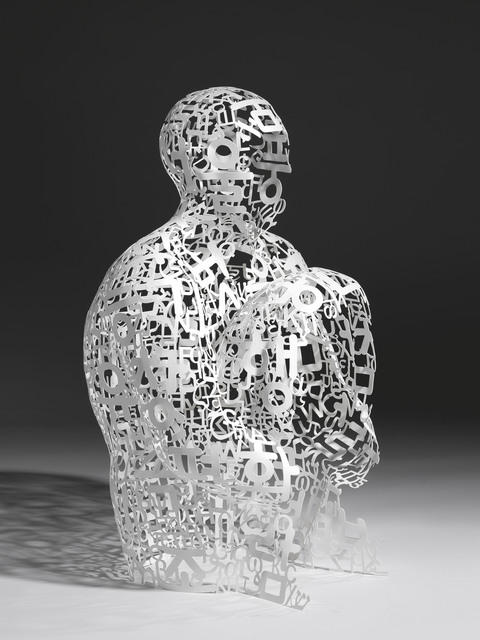
Jaume Plensa | Korea's Soul (2017) | Available for Sale | Artsy


More often than not, one uses “trauma” to describe a physical ailment. However, as we come to know more about trauma, describing a single event—physical or psychological, as ‘traumatic’ often ignores its role as a historical-political-social phenomenon that pertains to much more than an individual’s history. Scholars Neil J. Smelser and Ron Eyerman explain how trauma, as a historical-political-social phenomenon, can also be generational and cultural. When the specific trauma is cultural, “indelible marks upon [the victims’] group consciousness [are left], marking their memories forever, and changing their future in fundamental and irrevocable ways.” This chronic and cumulative trauma that has been “woven into the fabric of our societies”[1]  does not elicit the same “shock” or surprise factor that trauma, as defined by Caruth, must. Due to the ways in which the trauma of racism, misogyny, homophobia, xenophobia, etc., has become naturalized, classified as social disturbances yet so distant that they still require excavation and estrangement on the part of the dominant culture, these acts of violence are not readily regarded as ‘traumatic.’ But it is. Perhaps it is the lack of appropriate language within the fields of trauma studies that has caused this sort of cognitive dissonance, disregarding the stories that are tossed aside as being ‘anomalous.’

Sigmund Freud defined trauma and its memory as “a foreign body which long after its entry must continue to be regarded as an agent that is still as work”[2] –his definition stemming from his own experiences with trauma. However, because of his assertion that trauma remains dormant in one’s mind until ‘ready’ (which he describes as latency), much of the literary theory on trauma writing reflects such.[3] The cycle of repression, denial, numbing, recurrence, and working-through has primarily shaped contemporary literary trauma theory. Scholars such as Cathy Caruth[4] were responsible for much of the early scholarship, popularizing that trauma is an “unrepresentable event.”[5] Caruth furthers this by suggesting that trauma is “an unsolvable problem of the unconscious that illuminates the inherent contradictions of experience and language,”[6] arguing that a traumatic experience is not possessed by an individual or group. Hence, its impact is unable to be captured by direct reference. This classic theory mostly fails to note an agent’s responsibility, either an independent person or some traumatic event that actively causes the trauma experienced by a subject. Like Freud, Caruth’s perception of trauma, specifically trauma theory in writing,  only accepts dissociation as an appropriate response to a traumatic event, claiming that “…trauma is never simply one’s own.”[7] Caruth’s dissociative model of trauma also supports the claim that “one’s trauma is tied up with the trauma of another,” that trauma “is not known in the first instance” but rather, it “returns to haunt the survivor later on.”[8] This paradoxical removal of agency, where survivors who have experienced a traumatic event have the “absolute inability to know it,” restricts trauma’s variability, claiming that it is literature’s indirectness—its figurative language, gaps in speech, and linguistic particularities— only that has the ability to transmit the force of a traumatic history. However, recently, scholarship has turned to look at trauma theory and, more specifically, trauma writing in a more pluralistic view.  This view recognizes that although survivors may have had little agency in the moment of the traumatic event, there is variability in trauma, its definition, and representations, allowing for its determinant value and social specificity. By building off the previous explications of literary trauma theory to include the more mundanely catastrophic instances of trauma— “the violence not of lynching but of everyday racism,”[9] as these experiences also had a decisive and deforming effect on the psyche—one can begin to understand the variance of trauma expression.

This is why I chose to look at the trauma writings of the survivors of the Cultural Revolution and the Gwangju Uprising. Though the personal experiences of the individuals that have survived these events vary, they are undeniably tragic. Both resulted in the loss of lives of those who defied what the government declared as ‘correct’, were rooted in communist ideologies, and fundamentally changed the people of their respective nations’ identities.

As we advance towards the more pluralistic view on trauma and what it means to express oneself through writing, cultural competence and attention to humans’ diversity must be taken into account when analyzing and researching to understand responses to trauma. According to Laurence J. Kirmayer, the Director of Social and Transcultural Psychiatry at McGill University, although Post-Traumatic Stress Disorder (PTSD) borne out of a traumatic experience may present similarly across cultures, the interpretations of these symptoms is varied and diverse[10]. The studies of trauma and trauma writing are currently quite limited to a Western-centered analysis, but utilizing textual analysis, topic modeling, and tracking the changes in responses over time (through Hierarchical Latent Dirichlet Allocation—hLDA)[11] may result in more accurate culturally-specific analyses of trauma.


[1] 2Greg. Forter, “Freud, Faulkner, Caruth: Trauma and the Politics of Literary Form,” Narrative 15, no. 3 (2007): pp. 259-285, https://doi.org/10.1353/nar.2007.0022. p.60

[2] Neil J. Smelser. 2004. 2 Psychological Trauma and Cultural Trauma. Cultural Trauma and Collective Identity. Berkley, California: University of California Press, pg 33

[3] Balaev, Michelle. 1 Literary Trauma Theory Reconsidered. In: Michelle Balaev, ed. Contemporary Approaches in Literary Trauma Theory. Pallgrave MacMillan, Pg. 1

[4] Cathy Caruth can easily be regarded as one of the forerunners of literary trauma theory, and although I tend to agree with her notion that literature and trauma are intimately connected, she loses me when she describes trauma as being unknowable to the victim. I think there are many cases in which this can be seen as possible—the reliving of an event and realizing it was something traumatic, for example—however, the removal of a victim’s agency in the moment of is irresponsible and does not account for trauma that is not “shocking”. Punctual acts of violence, particularly those that are acted out against marginalized groups, have been “socially sublimated into ongoing, systemic practices and patterns of behavior.”

Forter, “Freud, Faulkner, Caruth: Trauma and the Politics of Literary Form,”p 260

[5] Michelle Balaev, “1 Literary Trauma Theory Reconsidered,” in Contemporary Approaches in Literary Trauma Theory (Basingstoke: Palgrave Macmillan, 2014). pp 2-3

[6] Ibid, p 1

[7] Ibid, p. 7

[8] Ibid, p. 6

[9] Forter, “Freud, Faulkner, Caruth: Trauma and the Politics of Literary Form,”p 260

[10] Kirmayer, Laurence J. “Nightmares, neurophenomenology and the cultural logic of trauma.” Culture, medicine and psychiatry vol. 33,2 (2009): Pg. 323-31.

[11] Topic modeling refers to the process of unsupervised analysis of a corpus in order to pull out specific sets of keywords based on multiple scans of the corpus. The outputs for my topic modeling included clusters of words (topics) that the model put together to infer the relations. Latent Dirichlet Allocation (LDA) assumes that the corpus is composed of words that help determine the topics and maps documents to a list of topics by assigning each word in the corpus to different topics. When you run an hLDA analysis, the program generates a feature tree that includes two hierarchies, the feature hierarchy and the file structure hierarchy. This way, one can view and draw conclusions on how the topics changed over time.

HISTORY OF THE GWANGJU UPRISING

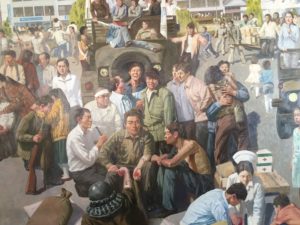
2 Days in May That Shattered Korean Democracy | The Nation

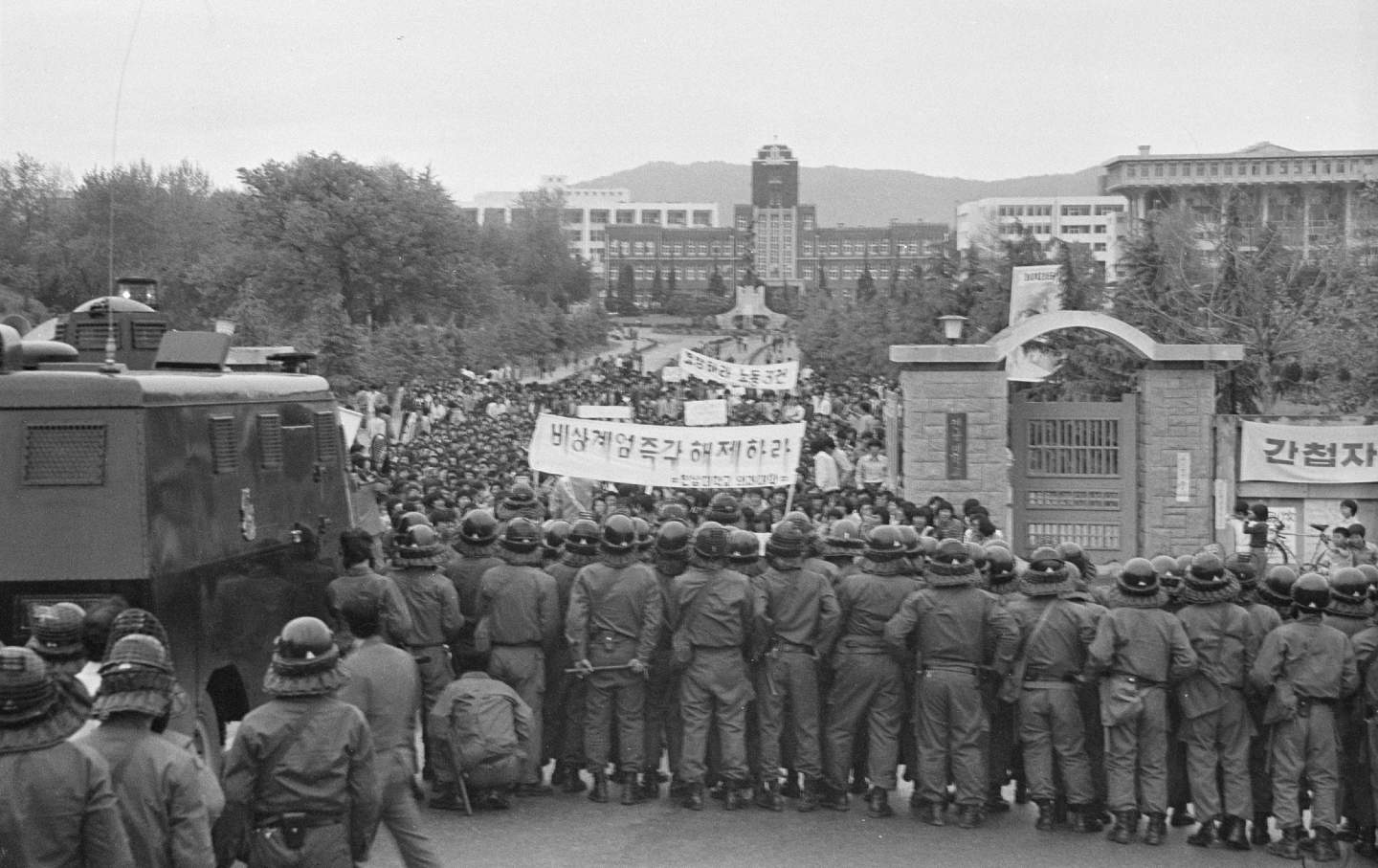
The Gwangju Uprising, also known as the May 18th Gwangju Democratization Movement, or simply, 5.18, occurred in Gwangju, Jeolla-do, South Korea from May 18th to May 27th, 1980. Students and faculty from Chonnam National University (CNU) led the democratization movement. As protests against the military dictatorship with Korea began, they were met with heavy suppression as the reign of Park Chung-hee[1] continued. It would not be until after his assassination in 1979 that the democratization movements across the peninsula resumed with a refound vigor. Although President Choi Kyu-hah[2] would come to power after President Park, he would not remain there for very long. The subsequent coup d’état by army general Chun Doo-hwan[3]would spark what was to become one of the world’s most forgotten and discredited democracy movements.

It would be the brutal death of Kim Gyung-cheol, a deaf 29-year-old in the wrong place at the wrong time, that would spark outrage amongst the people of Gwangju. What began as a march of roughly 600 students protesting against the suppression of academic freedoms soon ballooned into a city-wide demonstration of nearly 250,000. To combat the violent riot police and paratroopers sent out and ordered by Chun Doo-hwan, citizens broke into armories, arming themselves with whatever that could find. Brutal is an understatement. Footage of German reporter Jürgen Hinzpeter showcases how heinous the attacks on the citizens of Gwangju indeed were. Uncensored, bloody, beaten bodies, both alive and dead, in caskets and left on the streets, are filmed. The abuse of power and blatant lies told by Korean officials that the protestors were “communist insurgents”[4] was exposed to the world, as Hinzpeter’s smuggled footage is aired first in Germany, then subsequently on news stations internationally. The protests would last until May 27th, 1980, ending with Chun sending in tanks, armored vehicles, and even helicopters, ordered to attack indiscriminately[5]. Though Chun would later be sentenced to death for his orders to hunt down civilians, he would later be exonerated by President Kim Young-sam in 1996. While official reports claim the death toll to be around 200, Gwangju citizens argue that a minimum of 2,000 people were killed[6].

[1] Park Chung-hee was the father of former President Park Geun-hye, who was famously, the first female and the first impeached president for the nation. She subsequently received a sentence of 24 years in prison for corruption, abuse of power, influence-peddling, and colluding with notable pseudo-Christian cult leader’s daughter, and former advisor to Park Geun-hye, Choi Soon-sil. Although Park Chung-hee did not have the same sort of public scandal as his daughter, he would be known for coming to the presidency after first leading a strict military dictatorship, installed by the May 16th military coup d’état. Although his policies and economic growth would lead to the rapid industrialization and “Miracle on the Han River”, these programs came at the cost of the civil liberties and political freedoms of the citizens. It would be because of this that Park Chung-hee began to lose the popular vote, and multiple assassination attempts would be made on his life, one of which would claim his wife, Yuk Young-soo.

[2] After Park Chung-hee’s assassination, Choi would remain in office for less than a year as South Korea’s fourth president. From October 26th to December 6th, Choi would make promises of democratic elections and a new constitution to replace the Yushin Constitution. The Yushin Constitution was a heavily authoritarian document, the name alluding to the Meiji Restoration, its “imperial” role attached to Park’s presidency. This document extended the presidency to a 6-year term with no term limits and although the president was to be indirectly elected through a publicly elected electoral college, the requirements were so strict that only one candidate could be on the conference’s ballot. None of Choi’s plans would come to fruition, as Chun doo-hee’s military coup would take place in December of 1979, gaining virtually all control over the government by early 1980. As Chun’s power was questioned by the growing demonstrations, Choi appointed him as head of the Korean Central Intelligence Agency (the same that killed Park Chung-hee) and declared martial law. Once martial law had been called by Choi, Chun became the de facto ruler of South Korea.


[3] Though Chun doo-hwan would not be assassinated, history does  indeed repeat itself, and the citizens of Korea fought tirelessly against the second military coup d’état under him, leading to the continued struggle of the people of Gwangju to be compensated for Chun’s actions. After being sentenced to death for his role in the Gwangju Massacre in 1996, he was pardoned by President Kim Young-sam. As of 2020, Chun has tried (and failed) multiple times to publish memoirs in which he defaces both reporters and survivors of the Gwangju Uprising, and though he has been sued multiple times, he remains adamant that he was not responsible (despite very clear evidence) for the massacre of Gwangju citizens. Cho Chul-hyun, a priest not immune to the slander of Chun Doo-hwan within his banned memoirs, called him “Satan wearing a mask” for his denial of responsibility after witnessing events such as helicopters shooting down citizens.

“(3rd LD) Former President Chun Stands Trial for Libel Over Gwangju Memoirs” Yohap News. March 11th, 2019

[4] In contrast to the “official” news outlet, Chosun Ilbo, which had close ties to the government, the Militant’s Bulletin began circulating on May 20th. Newspapers such as the Chosun Ilbo had categorized protestors as ‘hoodlums with guns’— a common tactic used by oppressive regimes to silence those fighting for the freedoms of marginalized groups.

Katsiaficas, George. In 1980: The Kwangju Uprising. The North-Eastern Federation of Anarcho-Communists, n.d.

[5] Jung, Da-min. “Chun Doo-Hwan Ordered 1980 Massacre Shooting.” Korea Times, May 14, 2019.

[6] “Archived copy” 5월단체, “5.18관련 사망자 606명” (in Korean). Yeonhap News. May 13th 2005. Archived form the original on December 2, 2013

HISTORY OF THE CULTURAL REVOLUTION

cultural revolution posters - Google Search | Chinese propaganda posters, Chinese propaganda, Protest posters

During the Cultural Revolution, China faced a dismantling of tradition, focusing on ridding themselves of the four olds, old ideas, old culture, old habits, and old customs[1]increased as the spread of Maoist rhetoric took hold. For many, their lives were uprooted so suddenly that there was no longer a place for them within society. As Mao continued to push the nation towards industrialization, those that could be left behind would be. However, Mao’s drive to uproot China’s traditions did not begin at the start of the Cultural Revolution, but twenty-four years prior— seven years before the Chinese Communist Party’s (CCP’s) victory in 1949. The Yan’an Forum, otherwise known as the Yan’an Forum on Literature and Art, was a part of the party’s first ideological mass movement[2], the Yan’an Rectification Movement. The conversation began as a question posed to Mao on the role of intellectuals within the Communist movement. It was then that the function of art and literature would begin to change. The shift towards creating for the party would set the stage later regarding a unified cultural policy. All cultural products would thus reflect the party’s motivations— not only should they reflect the working class and consider them to be the primary audience, but also to serve politics.

Despite the emphasis on Socialist Realism and Westernized art before the Cultural Revolution, Chinese traditions did not disappear. Throughout the 1950s and 60s, there was a varying degree of artistic freedoms granted, allowing for a sort of relaxed, middle-ground to be reached, walking a thin line between high art and political propaganda. However, by the mid-1960s, Mao had begun purging former officials. A stricter mood had replaced the once free and varied one. Jiang Qing, a former actress and Mao’s wife, rose to power as an official and was appointed to the Central Cultural Revolution Group (CCRG). There, she had direct control over the culture of the CCP’s new China and began to advocate for the implementation of guidelines based on the desired revolutionary qualities described by Mao at Yan’an, going further to include, in her own words, art that is “red, bright, and shining”[3](hong, guang, and liang). Anything that may be construed as counter to the movement, with supposed “secret messages and symbolism,” would earn the title of “black art.” Jiang Qing would hold exhibitions to expose the reactionaries that created them[4].

Formally beginning in the spring of 1966, Mao would launch his Great Proletariate Cultural Revolution. From 1966-1976, Mao’s Cultural Revolution, which was actually a series of political and cultural movements, served to cleanse the nation of any and all ideological dissent. Before its formalization as a political-ideological movement, Mao’s revolution would be characterized by literary critiques, political assaults, and discourse surrounding culture. The revolution can be divided into two periods, with period one (1966-1969) being known for the torture, sometimes to death, of people, the fanatical Red Guard, and the collective enthusiasm to destroy the former legal and governmental systems in place. Shifting from this, the second period (1969-1976) focused on reforming and re-educating the people. The Down to the Countryside Movement saw the exile of people, as young as high schoolers, from the cities to the remote countryside to “develop their talents to the full.” The fanatical Red Guards from the first period were also sent to the countryside to reform and re-educate the blacklisted intellectuals or the cadres[5] in concentration camps. Though it is widely regarded that the end of the Cultural Revolution came after Mao’s death in 1976, officially, it would not end until the following year. No sooner than that, however, did Deng Xiaoping begin to try and gain power. In September of 1977, Deng proposed the Boulan Fanzheng[6]. By 1978 Deng, with liberal protégé, Hu Yaobang[7] by his side rose to Mao’s former status and declared the supreme ruler of China[8].

[1] Spence, Jonathan. The Search for Modern China. 2nd ed. New York: W.W. Norton & Co., 1999. Pg 575

[2]The Yan’an Rectification Movement (1942-1944), The Chinese Communist Party would set up a base the mountainous and secluded, Yan’an, located in Shaanxi Province. After the completion of the Long March (1934-1935), members of the CCP would give work to radicalize peasants in the surrounding area, giving lessons on the basic principles of Maoist ideology. This would be done in three phases, would begin under the shadow of Mao’s speech “Reform in Learning, the Party and Literature” and end with the death of upwards of 10,000 people, especially new party members, being purged, tortured, and even, executed. Comprised of mostly volunteers, the CCP founded schools worked to fundamentally re-educate those that felt as if they were on the periphery of the National consciousness during this period of wartime. Schools such as the Lu Xun Academy of the Arts, named after the leading figures of modern Chinese literature were the backbone of Mao’s push towards the solidification of his place as a paramount figure in the CCP.

[3] Andrews, Julia F., “The Art of the Cultural Revolution” in Art in Turmoil: the Chinese Cultural Revolutionn, 1966-76. Hong Kong: Hong Kong University Press, 2010 pg. 48

[4] After the death of Mao and the fall of the Gang of Four, the artists who were once ridiculed and blacklisted under the authority of Jiang Qing quickly grew to prominence. Not only were they praised, they were commissioned to create murals on Mao’s mausoleum. These artists later took the name the”Stars” (xingxing pai), and as a group, would illegally display their new modernist art in Beijing parks. The works, which varied in subject matter and composition, incorporated styles that, under Mao, had been ‘erased’ in favor of socialist realism. Some of the works touched on political issues— namely Mao’s personality cult— and critiqued the entirety of the socialist art system. However, this did not last very long, and soon after they began, they disappeared from the art scene as Deng Xiaoping’s suppression of intellectual freedoms ushered in a new era for sort and literature.

[5] The cadre system of the CCP worked to train, organize, appoint, and oversee personnel to fulfill organizations across the country. Cadres are not only trained to be hard workers, but also to be loyal to the CCP and faithful to their ideology. Broadly, cadre refers to any member of the staff that was tasked with the management of party affairs— however, they may not be a member of the party themselves. What is most important is their dedication to the goals of the party. There are six different categories of cadres, and they can be employed in any sector of professional life from leadership positions at the national level to the so-called professional and technical level (included “specialists such as engineers, doctors, professors, artists,” etc)

Zheng, Yang (2003). Local Government and Politics in China: Challenges from Below (2015 ed.). New York: Routledge.

The concentration camps that the blacklisted intellectuals and cadres could be sent to included cowsheds (niupeng) and Cadre schools (ganxiao)


[6] The Boulan Fanzheng refers to the period in which Deng Xiaoping worked to “right” the Cultural Revolution. Gradually, the policies of Mao were dismantled, and the victims of the revolution were being rehabilitated. Deng worked to enact sociopolitical reforms yet sought little to no punishments for those involved with and responsible for the horrors of the Cultural Revolution. Presently, President Xi Jinping has slowly begun to reverse policies and reforms created during the Boulan Fanzheng, leading scholars to make the concerning claim of a ”new Cultural Revolution”

“Xi Jinping’s brand new Cultural Revolution”. Taipei Times. 2018-08-23.


[7] Hu Yaobang held the top office of the CCP from 1981-1987, first as Chairman and then as General Secretary. Hu would be responsible for pursuing the majority of the economic and political reforms under Deng’s rule, causing him to become the enemy of several elder party members. Hu would later be forced to resign as his attempts to make the government more transparent would lead him to be blamed for the increase in student protests that took place across China in 1987. It would be Hu’s death and demand for the reevaluation of his legacy that would lead to the 100,000-student march on Tiananmen Square (April 15th, 1989-June 4th, 1989). China’s very violent, and very global suppression of the ’89 Democracy Movement would cause the CCP to heavily censor the details of Hu’s life, later revitalizing his reputation on his 90th birthday.


[8]邓小平是真理标准问题大讨论的发动者与领导者”. People’s Daily (in Chinese).4